03 July 2026
Eco-Construction: Why Pozzolan is the Future of Sustainable Building
A millennia-old material favored by Roman builders, pozzolan is now establishing itself as the pillar of modern eco-construction. From Life Cycle Assessment (LCA) to lightweight concrete, green roofs, HQE/LEED certifications, and its impact in Morocco, discover our comprehensive technical dossier on this exceptional volcanic aggregate.
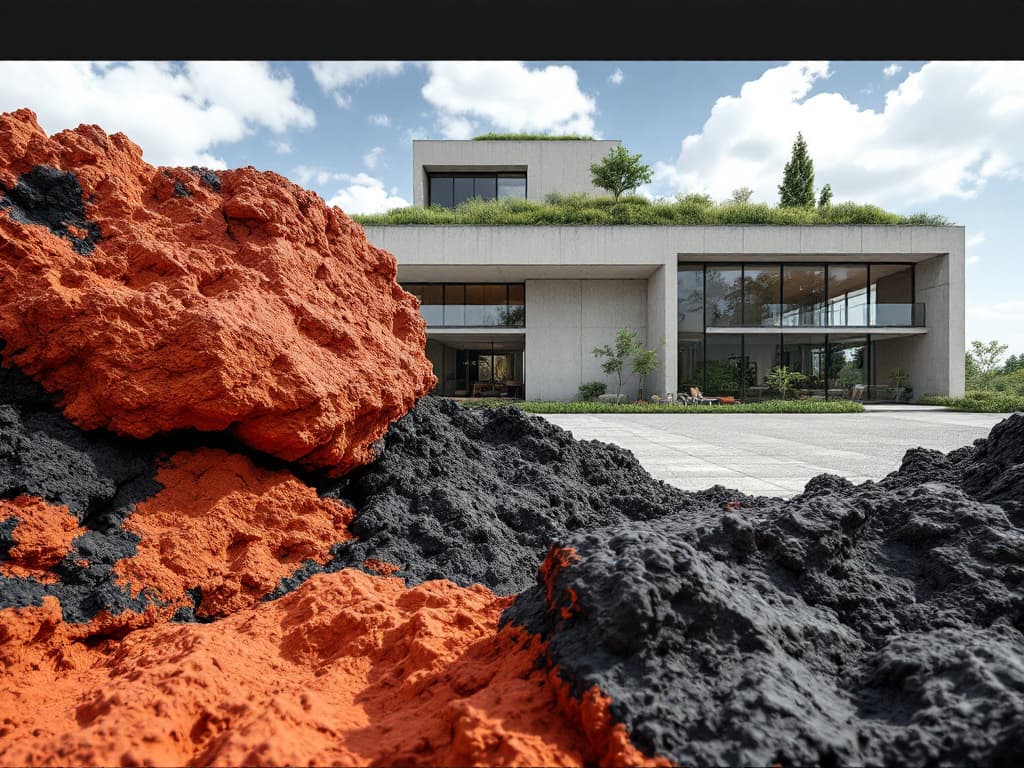
Eco-Construction: Why Pozzolan is the Future of Sustainable Building
Faced with global climate challenges, the depletion of natural resources, and the urgent need to reduce the carbon footprint of buildings, the construction and civil engineering sectors are experiencing an unprecedented paradigm shift. Professionals—architects, environmental consulting firms, structural engineers, and project owners—are actively seeking solutions capable of reconciling high mechanical performance, extreme durability, and strict environmental compliance.
Among the natural materials that meet these drastic requirements, volcanic pozzolan stands out as an essential benchmark. Masterfully used since Antiquity, notably by the Romans to build millennia-old structures like the Pantheon in Rome, it is now returning to the forefront of architectural innovation. Its intrinsic technical and ecological qualities make it a powerful ally in lightweight pozzolan concrete, low-carbon pozzolanic cement, and green roof systems.
This comprehensive technical dossier deeply explores the reasons why volcanic rock is reshaping the eco-construction landscape, with a precise look at its Life Cycle Assessment (LCA), its advantages over competing materials, its role in environmental certifications (LEED, BREEAM, HQE), and its strategic applications in Morocco.
[Suggested internal link: Discover our catalog of bulk pozzolan for construction professionals]
1. Geology and Physico-Chemical Characteristics of Pozzolan
To understand the performance of pozzolan in modern construction, one must first analyze its geological genesis and its intimate structure.
1.1 An Explosive Volcanic Formation
Pozzolan is an effusive magmatic rock. It forms during explosive volcanic eruptions. Magma, rich in dissolved gases (water vapor, carbon dioxide), is violently projected into the atmosphere. During its sudden cooling upon contact with the air, the gases escape, freezing the mineral matter into an extremely porous alveolar and vacuolar structure. It is this frozen "stone foam" that gives birth to pozzolan.
1.2 Mineralogical Composition and Chemical Reactivity
From a chemical standpoint, pozzolan is a silico-aluminate. It is predominantly composed of:
- Silica (SiO2): 40 to 50% (responsible for pozzolanic reactivity).
- Alumina (Al2O3): 15 to 20% (participates in the formation of hydrates in cement).
- Iron oxides (Fe2O3): 10 to 12% (giving its characteristic red to brownish color).
- Alkaline compounds (CaO, MgO, K2O, Na2O): in varying proportions.
The fundamental aspect of pozzolan lies in its vitreous (amorphous) state. Unlike crystallized rocks (like granite), the disordered structure of pozzolan makes it chemically reactive at room temperature in the presence of water and lime. This is the foundation of pozzolanic reactivity, the keystone of modern cement chemistry.
1.3 Remarkable Physical Properties
- Low Bulk Density: Ranging between 700 and 1000 kg/m³ depending on the granulometry, compared to 1500 to 1800 kg/m³ for a classic aggregate (limestone or siliceous gravel).
- High Porosity: From 30 to 60% internal voids, which gives it excellent thermal insulation and water retention capabilities.
- Mechanical Strength: Despite its lightness, its honeycomb structure gives it excellent crush resistance, measured by satisfactory Micro-Deval and Los Angeles tests for many structural uses.
- Incombustibility: Being a rock of igneous origin, it is classified as A1 (incombustible) and offers exceptional fire resistance.
2. Life Cycle Assessment (LCA) of Pozzolan: An Unrivaled Carbon Footprint
Eco-construction requires measuring the environmental impact of a material from extraction to end-of-life, according to the standardized Life Cycle Assessment (LCA) method. Compared to manufactured artificial aggregates, pozzolan presents a remarkable eco-balance.
2.1 Extraction and Production Phase (Cradle to Gate)
Unlike the production of expanded clay pebbles or cellular glass, the exploitation of pozzolan requires no high-temperature industrial firing. In quarries (for example, in the Middle Atlas deposits in Morocco), extraction is done in open pits using mechanical means (excavators, loaders). The only processing operations are limited to mechanical crushing and screening to classify the material by granulometries (0/3, 3/6, 7/15, 20/40 mm).
The Embodied Energy (total energy consumed throughout the life cycle) of pozzolan is negligible: estimated between 15 and 30 kWh/m³, compared to over 700 kWh/m³ for expanded clay. CO2 emissions linked to production are therefore solely attributable to quarry machinery and crushers, which represents a tiny fraction of the emissions from industrial aggregates.
2.2 Transport Phase
Although transport is the main emission source for natural aggregates, the lightness of pozzolan works in its favor. A dump truck can transport a significantly larger volume (m³) of pozzolan than dense gravel before reaching the Maximum Authorized Weight. This proportionally reduces the number of truck rotations, diesel consumption, and Greenhouse Gas (GHG) emissions per cubic meter delivered to the site.
[Suggested internal link: Learn more about our bulk pozzolan delivery logistics]
2.3 Use and End of Life Phase (Cradle to Grave)
The durability of volcanic rock is infinite on a human scale. It suffers no degradation from ultraviolet rays, freezing, thawing, or bacteriological attacks. At the end of the building's life, pozzolan (whether used as mulch, in a drain, or as loose-fill insulation) is 100% inert, 100% reusable, and 100% recyclable. It can be recovered and reintegrated into a new construction cycle, perfectly responding to the principles of the circular economy.
3. Pozzolanic Cement: A Chemical and Environmental Revolution
The global cement industry is responsible for about 7 to 8% of global CO2 emissions, mainly due to clinker production (firing limestone and clay at 1450°C, causing decarbonation). The integration of pozzolan allows for massive decarbonization of this industry.
3.1 The Chemistry of the Pozzolanic Reaction
In classic Portland cement (CEM I), hydration produces hydrated calcium silicate (C-S-H, responsible for solidity) and calcium hydroxide (free lime or portlandite). This free lime has no binding value and represents the weak point of concrete against chemical attacks.
This is where the magic of pozzolan comes in. Composed of amorphous silica, it reacts cold with this free lime in the presence of water.
The simplified chemical equation is: Pozzolan (Reactive Silica) + Hydrated Lime (Ca(OH)2) + Water -> Secondary C-S-H.
This reaction transforms the chemical "waste" (lime) into an additional and extremely strong binder. The capillary pores of the concrete gradually become blocked, making the matrix increasingly dense and impermeable over months or even years.
3.2 Cement Types (CEM II, CEM IV, CEM V)
The European standard EN 197-1 regulates the use of pozzolan (natural, denoted "P", or calcined, denoted "Q") in cements. Composite cements (CEM II/A-P or CEM II/B-P), pozzolanic cements (CEM IV), and composite cements (CEM V) incorporate proportions ranging from 6% to over 50% of materials with pozzolanic behavior. Replacing 30% of clinker with pozzolan means an almost proportional reduction in the cement's carbon footprint.
3.3 Exceptional Durability for Civil Engineering Structures
Concretes formulated with pozzolanic cements offer superior longevity guarantees, essential for large-scale projects, ports, or dams:
- Sulfate and Chloride Resistance: The consumption of free lime and the reduction of porosity prevent the penetration of aggressive ions (like seawater). These concretes are perfect for marine environments and foundations in aggressive soils.
- Prevention of Alkali-Aggregate Reaction (AAR): Pozzolan fixes the alkalis in the cement, preventing the formation of destructive expansive gels known as "concrete cancer."
- Controlled Heat of Hydration: The pozzolanic reaction is slow and moderately exothermic. This reduces the risk of thermal cracking when pouring massive elements (raft foundations, dams).
4. Lightweight Pozzolan Concrete (LPC): Structural and Thermal Engineering
Lightweight Pozzolan Concrete (LPC) consists of replacing heavy aggregates (gravel and sometimes sand) with pozzolan aggregates. This formulation achieves concrete densities ranging from 1200 to 1800 kg/m³ (compared to 2400 kg/m³ for standard concrete).
4.1 Reduction of Structural Dead Weight
In the construction of High-Rise Buildings, rehabilitations, or upward extensions, the weight of the building is the structural engineer's main enemy. Using pozzolan concrete for floors, compression slabs, or facade walls reduces load descents by 20 to 30%. This leads to colossal chain savings: downsizing of steel reinforcements, shallower foundations, and the use of smaller diameter piles.
4.2 Integrated Thermal Correction
Standard concrete is a very poor insulator (thermal conductivity λ ≈ 1.5 to 2.0 W/m.K). Thanks to the air trapped in its pores, pozzolan concrete presents significantly lower thermal conductivity values (λ can drop to 0.4 W/m.K depending on the formulation). While it does not replace pure insulation (like rock wool or cork), it effectively treats structural thermal bridges (slab edges, balcony/wall junctions) and contributes to the building's overall thermal inertia, favoring summer comfort (passive cooling).
4.3 Acoustic Behavior
The porous structure of the rock and the difference in density between the cement paste and the lightweight aggregates allow the energy of sound waves to be absorbed. Blocks manufactured from pozzolan concrete (lightweight breeze blocks) or slabs offer an excellent sound reduction index (Rw), ideal for acoustic insulation between collective housing units or hotel rooms.
4.4 Fire Resistance (Tenue au feu)
During a fire, concrete with siliceous aggregates tends to burst (spalling phenomenon) due to differential expansion and water vapor pressure. Pozzolan, having already undergone volcanic "firing," has a low thermal expansion coefficient and a porosity that allows water vapor to escape without exploding the concrete. LPC walls offer exceptional fire resistance durations (Fire Retardant / Fire Proof), often exceeding 2 or 3 hours.
5. Comparative Study: Pozzolan vs. Expanded Clay vs. Pumice
In the market of lightweight aggregates for eco-construction, consulting firms often hesitate between several materials. Here is an in-depth technical analysis to position pozzolan.
Technical Criterion Volcanic Pozzolan Expanded Clay (Synthetic Aggregate) Pumice Origin and Process Raw natural rock, simply crushed and screened. Extracted clay, then fired in industrial rotary kilns at ~1200°C for expansion. Natural volcanic rock, highly aerated. Bulk Density 700 to 1000 kg/m³ (Light to medium). 300 to 800 kg/m³ (Very light). 350 to 600 kg/m³ (Extremely light). Embodied Energy (Carbon Footprint) Very low (~20-30 kWh/m³). Ideal for eco-construction. Very high (>700 kWh/m³). Heavy carbon impact during industrial firing. Very low (~20 kWh/m³). Mechanical Strength (Compression) Excellent. Suitable for structural concrete, road sub-bases, and heavy drains. Good, but the aggregate can crush under heavy concentrated loads. Low. Crumbles easily under pressure. Reserved for insulation and very light non-load-bearing concrete. Drainage Capacity Exceptional. Very rough shape creating multiple stable macro-voids. Good, but spherical shape limits mechanical interlocking. Good, but risk of excessive water retention (sponge effect) and frost shattering. Chemical Reactivity (Pozzolanic) Very high (Amorphous silica). Binds with lime. Inert. Moderate to High. Economic Cost Very competitive, especially if close to a quarry (E.g., Middle Atlas in Morocco). Expensive manufactured material. Impacted by gas/energy prices. Quite high, as quality deposits are geographically rare.Conclusion of the comparison: While expanded clay breaks records for lightness, its disastrous carbon footprint often disqualifies its use in very strict High Environmental Quality (HQE) projects. Pumice is thermally excellent but lacks structural strength. Pozzolan therefore asserts itself as the ultimate compromise: mechanical strength allowing for heavy uses, significant lightness, and an unbeatable carbon footprint.
6. Green Roofs and Urban Stormwater Management
Rapid urbanization and soil sealing pose critical problems of urban flooding and create Urban Heat Islands (UHI). The green roof is one of the most powerful architectural responses to these challenges. Pozzolan is its foundation material.
6.1 The Perfect Mineral Substrate
A green roof (whether extensive, semi-intensive, or intensive) cannot use standard topsoil. It would be far too heavy once waterlogged, would risk suffocating (root rot), and eroding in the wind. The growing medium must be a carefully dosed mix (often 70 to 80% mineral to 20 to 30% organic). Calibrated pozzolan (often 3/6 mm or 7/15 mm) is the mineral constituent par excellence.
- Structural Lightness: It allows for the creation of green roofs on light frameworks or steel decks without over-dimensioning the load-bearing structure.
- Maximum Water Retention Capacity: The rock's cavities store rainwater, slowly releasing it to the plants (Sedums, grasses) during dry periods, thus reducing watering needs.
- Continuous Root Aeration: Its angular shape prevents the substrate from compacting over time. Oxygen circulates freely, ensuring a healthy root system.
- Unalterability: Unlike pine bark or compost, it does not settle, blow away, and does not require massive top-ups after a few years.
6.2 The Drainage Layer and Storm Management
Beneath the substrate, a pure drainage layer is often created using large-caliber pozzolan (20/40 mm). This layer acts as a miniature storm basin on the roof. During torrential rains, water passes through the substrate, fills the macro-voids of the pozzolan drainage layer, and is then discharged at a delayed and slowed rate to the gutters. This flood peak attenuation phenomenon considerably relieves the city's sanitation networks and prevents flooding.
[Suggested internal link: Guide to choosing the ideal pozzolan granulometry for your green roof]
7. Pozzolan and International Environmental Certifications (HQE, LEED, BREEAM)
The value of a modern building on the commercial or institutional real estate market is today dictated by obtaining demanding environmental labels. Integrating pozzolan into a project's technical specifications allows designers to garner precious points (or credits) in the evaluation grids of these certifications.
7.1 LEED v4 Certification (Leadership in Energy and Environmental Design) - US / International
In the LEED certification driven by the USGBC, the use of pozzolan favorably impacts several major credits:
- Sustainable Sites (SS) - Rainwater Management: Using pozzolan in green roofs or ground infiltration swales helps manage stormwater on-site, awarding up to 3 points.
- Sustainable Sites (SS) - Heat Island Reduction: Green roofs on pozzolanic substrates combat heat islands, earning direct points.
- Materials and Resources (MR) - Building Life-Cycle Impact Reduction: Replacing Portland cement with pozzolanic cement (or ash/slag) optimizes the building structure's LCA, a flagship category of LEED v4 (up to 3 points).
- Materials and Resources (MR) - Sourcing of Raw Materials: If the pozzolan quarry is located geographically close to the site, this values short supply chains and locally extracted materials.
7.2 BREEAM Certification (Building Research Establishment Environmental Assessment Method) - UK / International
BREEAM evaluates the building on similar criteria, where volcanic rock proves very useful:
- Materials Category (Mat 01 - Life cycle impacts): The use of lightweight pozzolan concrete or composite cements lowers the overall environmental impact via Environmental Product Declarations (EPD).
- Water Management Category (Pol 03 - Surface water run-off): As with LEED, drainage systems and pozzolan green roofs maximize the score by mitigating runoff peaks and surface water pollution (pozzolan also acts as a physico-chemical filter capturing certain pollutants and hydrocarbons).
- Ecology Category (LE 03 - Mitigating ecological impact / LE 04 - Enhancing site ecology): Creating ecological environments on the roof on a mineral substrate recreates urban biodiversity, a strong BREEAM prerequisite.
7.3 HQE Approach (Haute Qualité Environnementale) - France / Morocco
Particularly influential in Morocco via "HQE Cerway" and driven by green building initiatives in Casablanca, Rabat, or the green city of Benguerir, the integration of pozzolan validates several "Targets" of the framework:
- Target 2: Integrated choice of construction products and processes. (Natural, inert material, low embodied energy, favorable EPD).
- Target 5: Water management. (Green roofs, draining trenches).
- Target 8: Hygrothermal comfort. (Thermal inertia of lightweight concrete and evapotranspirative cooling of green roofs).
8. Applications and Case Studies of Pozzolan in the Moroccan Context
Morocco is now positioning itself as an African leader in energy transition and sustainable development. Moroccan geology, notably in the Middle Atlas region, is full of high-quality historical volcanic deposits (such as in the Azrou, Timahdite, and Aguelmous regions).
8.1 Valorization of the Local Resource: Short Supply Chain and Circular Economy
For major construction sites in Casablanca, Rabat, or Tangier, sourcing volcanic rock from Middle Atlas quarries presents a major logistical asset. Recourse to bulk pozzolan in Morocco eliminates the need to import expensive and polluting synthetic insulation materials, favoring the local economy, creating jobs in the regional mining industry, while drastically cutting emissions linked to international maritime and road freight.
8.2 The Thermal Challenge in Arid and Semi-Arid Climates
In Morocco, in cities like Marrakech, Ouarzazate, or Agadir, the main issue is summer comfort and combating building overheating. Local eco-construction is turning to pozzolan for two main applications:
- Integration into the building envelope: Building blocks (breeze blocks) or cast-in-place concrete integrating local pozzolan offer significantly higher thermal resistance than standard hollow cement blocks. This thermal inertia slows the penetration of daytime heat into the home, smoothing temperature peaks and drastically reducing the intensive use of air conditioning.
- Thermal mineral mulching: Around buildings, in the landscaping of hotel resorts and public parks, pozzolan mulching protects soils from extreme evaporation caused by the Moroccan sun. Unlike organic mulches (bark) that degrade quickly or attract pests, volcanic mulch stays cool, shades the soil, saves irrigation water, and provides a highly prized red or black aesthetic in Andalusian or contemporary gardens.
8.3 Theoretical Case Study: An Eco-Resort in the Palmeraie of Marrakech
Imagine a construction project for a luxury tourist eco-resort aiming for high-level environmental certification. The architect decides to massively integrate the local volcanic resource:
- Structural Works: The foundations in a slightly sulfated environment use a composite cement integrating pozzolan. The load-bearing walls are made of Lightweight Pozzolan Concrete (LPC) blocks, ensuring natural summer comfort.
- Sanitation: As the complex is not connected to the city network, the architect installs an autonomous wastewater treatment plant using reed bed filters (phytopurification). The filter bed consists of cubic meters of calibrated pozzolan. Its large specific surface area allows optimal attachment of purifying bacteria that degrade the organic matter from the hotel's wastewater. The purified water is then used to irrigate the park.
- Roofing and Landscape: The flat roofs of the villas are covered with extensive green terraces on a pozzolanic substrate. On the ground, cactus gardens and pedestrian paths are enhanced by mulches and volcanic gravel.
Outcome of the operation: Relying on a B2B pozzolan supplier allows for economical bulk delivery. The carbon footprint of the structural work is reduced, water management is autonomous and circular, and the hotel offers exceptional passive cooling. The initial extra cost is amortized in less than 5 years on energy and water savings alone.
[Suggested internal link: Discover our guide for hospitality professionals on outdoor landscaping with pozzolan]
9. Summary of Practical Applications of Pozzolan in Eco-Building
To summarize the breadth of possibilities offered to architects and construction companies, here is the list of applications where volcanic rock excels:
- Structural and non-structural lightweight concretes.
- Insulating shape slabs and lightweight screeds.
- Dry or lightweight screeds (for renovating old wooden floors where weight is limited).
- Thermal insulation of attics or cavity walls (blowing or pouring fine bulk pozzolan).
- Green roofs, garden terraces, and water-retention roofs.
- Peripheral drainage of foundation walls (to prevent capillary rise and basement dampness).
- Making technical and bastard mortars.
- Ecological sanitation and compact filters (septic tanks, micro-stations).
- Decorative and exposed aggregate concretes.
- Manufacturing of building blocks (lightweight breeze blocks, insulating bricks).
- Sustainable outdoor landscaping (roadways, landscape swales, decorative gabions filled with volcanic rock).
10. Why do Professionals (Construction and Landscaping) Strategically Choose Bulk Pozzolan?
The ecological transition will not happen to the detriment of technical feasibility or the economic viability of companies. Project owners choose pozzolan because it solves a complex equation with multiple unknowns.
Procuring bulk pozzolan via a wholesaler or a direct quarry operator perfectly answers this equation by ensuring:
- Industrial Logistics: Delivery in dump semi-trailers capable of supplying massive sites with hundreds of cubic meters, reducing the transport carbon footprint per volume transported.
- Rigorous Cost Control (TCO): Elimination of packaging costs, time-consuming handling hours, and site waste. Overall profitability is significantly improved.
- Technical Adaptability: Availability of custom millimeter screening (0/3 for plasters, 7/15 for landscape, 20/40 for civil engineering drainage) to match the Specifications exactly.
- The CSR Asset (Corporate Social Responsibility): Valorization of a natural, non-toxic material, inexhaustible on a human scale, recyclable, and locally sourced for Moroccan markets. It is a powerful lever for communication and winning eco-conditioned public contracts.
Technical FAQ: Answers for Construction Professionals
Is pozzolan suitable for building individual houses (Villas)?
Yes, absolutely. It can be integrated from the foundations (peripheral drains to sanitize the crawl space), into the elevation walls (lightweight insulating blocks), on the roof (urban flat green roof), and of course in enhancing outdoor spaces (water-wise gardens, drivable paths with cellular structures).
Is lightweight pozzolan concrete (LPC) sufficiently load-bearing and strong?
Yes. If it is correctly formulated in a concrete batching plant (with an optimized Water/Cement ratio, the use of plasticizing or superplasticizing admixtures, and a pre-water-saturated aggregate), lightweight pozzolan concrete can reach compressive strengths of 25 to 40 MPa. This is more than sufficient for load-bearing structural applications while reducing the dead weight of the structure by 25%.
Why do engineers specifically prescribe a pozzolanic cement near the sea?
The marine environment is extremely aggressive for concrete (chloride ions from salt water attack and rust the steel reinforcements, causing the concrete to burst). Pozzolanic cements consume free lime, block capillary porosity, and render the concrete matrix very dense, chemically and physically preventing the penetration of these corrosive ions. They are the standard for constructing port infrastructures.
How is pozzolan recycled at the end of the building's life?
Unlike polystyrene or polyurethane foam which pose serious recyclability and pollution problems during demolition, pozzolan is a natural stone. Once the structure is demolished, pozzolan concrete can be crushed and transformed into recycled aggregate for road sub-bases. Pozzolan used on a roof, in a drain, or in landscaping can be directly screened, washed, and reused as is on a new site. Its life cycle is technically infinite.
Conclusion: The Founding Rock of Tomorrow's Architecture
Eco-construction is no longer a niche trend or a utopian experiment; it now represents the norm, the indispensable and immediate future of the Building and Public Works sector. To succeed in this monumental shift, the sector can no longer rely exclusively on the energy-intensive materials of the 20th century. It must innovate, paradoxically, by turning to ancient and proven telluric resources. Pozzolan plays and will continue to play a central role in this technological and environmental evolution.
Thanks to its extraordinary natural qualities—structural lightness, draining porosity, pozzolanic chemical reactivity, thermal inertia, and incombustibility—it allows architects and engineers to design much higher-performing buildings, more energy-efficient structures, resilient to urban heatwaves, and fundamentally more respectful of the environment from day one of the construction site.
Whether it is formulating the lightweight pozzolan concrete of tomorrow, generalizing the use of pozzolanic cement to decarbonize the industry, preventing urban flooding with intelligent green roofs, or developing Moroccan public spaces with a sovereign resource, volcanic rock offers a concrete, robust, and economically viable response to the challenges of sustainable construction.
For a developer, a project owner, an architect, or a general contracting company, choosing to massively integrate bulk pozzolan into their specifications is much more than making a simple procurement choice. It is investing intelligently in a natural, durable, and ultra-high-performance material capable of supporting the ambition of today's construction projects, while actively and measurably participating in the global ecological transition of tomorrow.