01 July 2026
The Contractor’s Guide: Optimizing ROI and Logistics with Bulk Pozzolan
For construction, public works, and commercial landscaping professionals, optimizing logistical costs is vital. This exhaustive guide explores how a bulk volcanic pozzolan procurement strategy maximizes Return on Investment (ROI), secures project schedules, and improves on-site team productivity.
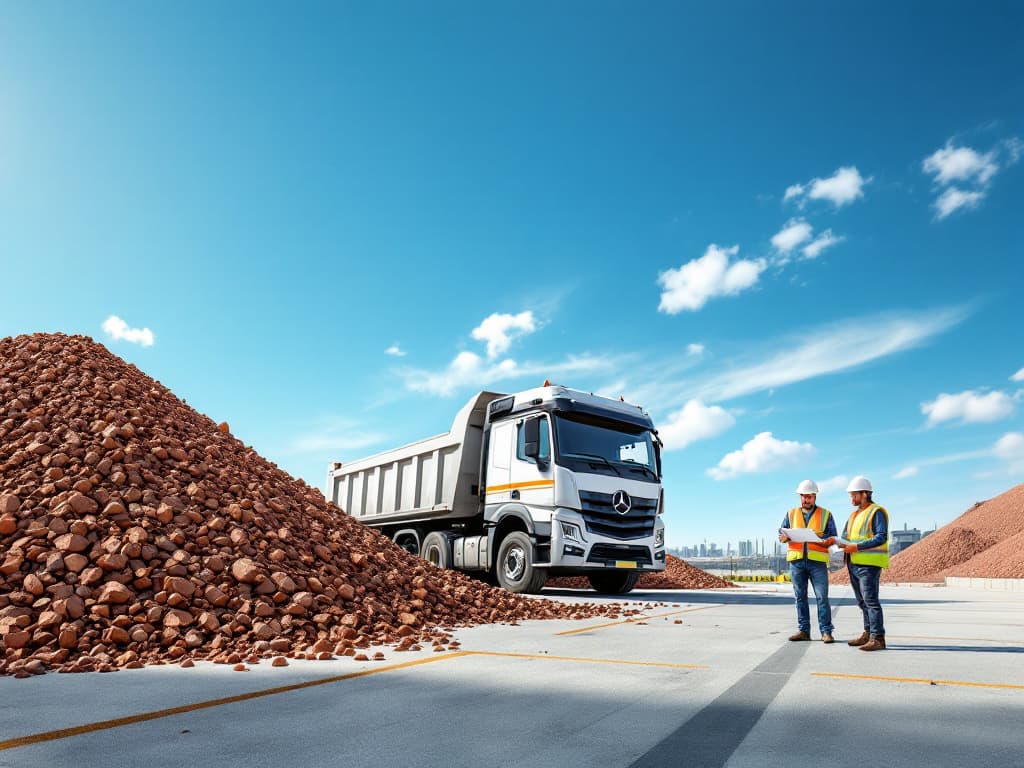
The Contractor’s Guide: Optimizing ROI and Logistics with Bulk Pozzolan
Introduction: The Strategic Stakes of Procurement in Construction and Landscaping
In the sectors of Building and Public Works (construction), large-scale commercial landscaping, infrastructure development, and civil engineering, every purchasing decision directly and measurably influences the overall profitability of a project. Today, faced with the increasing complexity of projects and the tightening of profit margins, procurement management is no longer limited to simply negotiating the unit price of basic materials.
Beyond the surface cost of materials, contracting companies, project managers, and buyers must now meticulously account for logistical costs, lead times, field team productivity, storage constraints, and increasingly, the environmental impacts associated with heavy transport. In this highly competitive context, bulk pozzolan stands out not only as a natural material of excellence but, more importantly, as a strategic lever for professionals looking to improve the overall financial and operational performance of their worksites.
Thanks to its exceptional draining properties, its light weight compared to traditional aggregates, its frost resistance, and its almost infinite durability, volcanic rock is used in a multitude of technical fields: heavy drainage of road platforms, urban landscaping, road design, creation of stormwater retention basins, substrates for green roofs, autonomous sanitation systems, and ecological filtration beds. But to fully exploit these physical and mechanical advantages, it is absolutely essential to adopt a truly integrated procurement strategy.
Choosing a reliable, industry-scaled B2B bulk pozzolan supplier, planning a pozzolan purchase per ton perfectly adapted to the actual phasing of the site, and optimizing the supply chain from end to end are all actionable levers that protect and improve the profitability of operations. This exhaustive guide presents the best industry practices to transform your pozzolan procurement into a true driver of economic and organizational performance.
Why is Bulk Pozzolan a Highly Profitable Choice for Professionals?
The value analysis of a construction or landscaping material must be holistic. The cost of a material is never limited to its purchase price at the quarry gate. For construction and landscaping companies, it is imperative to integrate heavy transport costs, handling times by operators and machinery, potential on-site losses, the cost of storage space, and the administrative organization of deliveries. From the perspective of the Total Cost of Ownership (TCO), bulk pozzolan presents multiple competitive advantages over packaging in bags or small big-bags.
Drastically Reducing the Delivered Cost per Ton
Purchasing materials in bulk is the first lever of financial optimization. It allows for the drastic reduction, or even elimination, of many ancillary costs linked to industrial packaging:
- direct packaging costs (plastics, wooden pallets, protective covers);
- upstream logistical handling costs (bagging, palletizing, shrink-wrapping);
- the cost of processing packaging waste on the site (which requires specific commercial waste dumpsters);
- fractional transport costs (a bulk dump truck often carries a much higher payload than a flatbed truck carrying pallets).
When dozens or even hundreds of tons are required to create a lightweight backfill or a vast landscaped park, the savings achieved by eliminating these intermediary costs become extremely significant. Companies can thus free up more comfortable margins or allocate a larger share of their budget to other strategic areas of the project, such as higher-quality finishes or more efficient equipment.
Saving Time on Handling and Installation Operations
On a construction site, the most expensive and difficult variable to control is often labor. Each additional manipulation of a material represents a direct cost in working hours, as well as the mobilization of lifting equipment (telehandlers, cranes, loaders). Team productivity is the key to commercial landscaping and construction profitability.
With a bulk delivery via dump truck, the material is unloaded directly in a few minutes into a designated transit storage area, or even directly "pulled" or spread over the application zone if accessibility allows. Field teams spend infinitely less time moving heavy pallets, cutting tough plastic packaging, manually emptying bags weighing dozens of kilos, and gathering waste. This streamlined workflow improves daily productivity, reduces physical strain (a major issue for Occupational Health and Safety - OHS), and accelerates the overall production rate of the site.
Minimizing Material Loss on Site and Securing the Resource
Storing poorly protected bags or pallets exposes the material to various risks inherent to the life of a busy construction site:
- accidental tears caused by the forks of handling equipment;
- deterioration of plastic packaging under prolonged UV rays or frost;
- theft of individual bags, which are much easier to steal than a pile of bulk rock;
- scattering of materials due to handling errors.
Bulk material, when properly stored on a prepared, leveled surface and ideally protected by a separation geotextile from the natural soil, significantly limits these losses. Furthermore, it facilitates a more visual and precise management of the volumes consumed daily, allowing the site manager to anticipate replenishments with high reliability.
Calculating Real ROI and the TCO (Total Cost of Ownership) of a Site
For a professional buyer, project profitability relies on the analysis of several performance indicators that go far beyond the simple purchase price per kilo or per ton of materials. The TCO (Total Cost of Ownership) approach is standard practice in large construction groups.
Before blindly comparing several quotes from different suppliers, it is highly advisable to evaluate the overall and actual cost of using pozzolan within the specific framework of your project.
Gross Acquisition Cost vs. Delivered Site Cost
The true acquisition cost does not stop at the ex-works (quarry gate) price. It must necessarily include:
- the net purchase price of the ton of volcanic rock according to the chosen granulometry;
- road transport fees (which can vary depending on distance, tolls, and fluctuating fuel prices);
- any specific delivery fees for difficult access (smaller trucks, crane trucks, specialized tippers);
- the administrative time spent managing orders and invoicing.
An offer that seems extremely attractive regarding the ex-works unit price can ultimately prove to be much less interesting, or even loss-making, if the extraction site is very far from the project and logistical costs skyrocket. A geospatial analysis of the supplier is paramount.
The Hidden Costs of Handling and Downtime
The time spent by your teams receiving, inspecting, moving, and preparing the material represents a massive hidden cost that silently eats away at your margins. Drastically reducing intermediate handling through well-planned bulk delivery allows you to:
- improve the hourly productivity of installation teams;
- significantly decrease the risk of workplace accidents (Musculoskeletal Disorders related to repetitive lifting);
- limit the wear, fuel consumption, and depreciation of internal site handling machinery;
- optimize the scheduling of co-activity with other trades present on the site.
These indirect savings, often called "friction costs," strongly influence the final financial balance of the project.
Costs Related to Delays and Site Penalties
In the construction industry, time is literally money. A break in the supply chain or a logistical failure by a transporter can trigger catastrophic cascading financial consequences:
- total or partial halt of work on the affected batch;
- unproductive immobilization of salaried staff and expensively rented machinery;
- disorganization and forced postponement of subsequent trades' interventions (asphalt laying, planting, street furniture installation);
- the application of very heavy daily delay penalties stipulated in public or private contracts.
Collaborating with a logistical partner and wholesaler capable of scrupulously respecting announced deadlines therefore constitutes a true strategic investment—a shield against hazards—rather than a simple expense line on the balance sheet.
Why Choose a Specialized B2B Pozzolan Supplier?
The natural materials market is full of players of various sizes. However, not all trading companies or intermediaries have the same logistical capacities or financial backing. For large-scale professional projects, it is infinitely preferable to work directly with a B2B bulk pozzolan supplier, or even a quarry operator, with proven experience in managing industrial volumes.
Massive, Regular, and Secured Supply Capacity
Major road infrastructure projects or eco-neighborhood developments sometimes require several thousand tons of volcanic rock, the delivery of which must be smoothed out and distributed over several weeks or even months, at the precise pace of the earthworks' progress. A specialized supplier must be able to contractually guarantee you:
- constant availability of stock in their quarry or transit platform;
- the ability to maintain continuity of deliveries, even during peak periods (high seasonal demand);
- production capacity to adapt to sudden accelerations or slowdowns on the site;
- infallible responsiveness in the event of an unforeseen issue or last-minute order modification.
This logistical security is the cornerstone of successful construction management.
Advanced Technical and Geotechnical Expertise
Pozzolan is not a generic product. Depending on its origin, it has different densities, porosities, and mechanical resistance capacities (Los Angeles test, Micro-Deval test). Moreover, not all projects absolutely require the same granulometry.
An experienced wholesale partner assists their professional clients in choosing the appropriate geotechnical characteristics based on:
- hydraulic objectives and permeability coefficients required for drainage;
- geotechnical constraints regarding bearing capacity and crush resistance under roadways;
- aesthetic and colorimetric requirements defined by the landscape architect or the client;
- strict construction standards (CE standards, local technical fascicles) applicable to the project.
This materials engineering makes it possible to provide the correct technical data sheets to control bureaus and avoid the astronomical extra costs associated with installing unsuitable material that would later need to be extracted and replaced.
Logistics Ultra-Adapted to Complex Professional Constraints
The requirements of a general construction company differ fundamentally from those of a homeowner landscaping their driveway. A supplier specializing in B2B has a fleet of vehicles or a network of high-capacity transport partners. They are capable of proposing and managing:
- planned and sequenced delivery schedules over long periods;
- the rapid mobilization of truck fleets (norias) for high-yield pouring or backfilling operations;
- compliance with ultra-strict time slots imposed by municipal police or urban site organization (nighttime or very early morning deliveries);
- a diversified fleet (walking floor semi-trailers, 8x4 or 6x4 rigid tippers, trucks with horizontal ejection bodies) to address issues of overhead clearance or site access.
Pozzolan Cost Per Ton: How to Accurately Determine Necessary Volumes?
On large projects, one of the major challenges for the buyer or project engineer is to order the exact quantity from the start. An inaccurate overestimation generates unnecessary costs, immobilizes surplus cash flow, and creates reprocessing fees at the end of the project. Conversely, an underestimation forces you to place small top-up orders, where the transport cost per cubic meter will be disproportionate, while also stalling the progress of the teams.
Formulas, Calculation Methods, and Bulking Factors
Calculating the theoretical volume primarily depends on the geometry of the structure:
- the exact surface area of the zone concerned (in square meters);
- the nominal thickness planned by the execution drawings (in meters);
- the apparent bulk density of the pozzolan according to its granulometry, which is essential to convert the volume (m³) into weight (tons) for ordering and invoicing.
It is fundamental to take into account the bulking factor and the compaction rate. During installation and the passing of a vibrating plate or a road roller, pozzolan settles. A non-compacted layer of 20 cm can reduce to 17 cm after compaction. A preliminary geotechnical study and a good knowledge of the product data sheets allow you to precisely model the exact tonnage to supply in order to achieve the final thickness validated by the project manager.
Planning a Reasonable Margin to Absorb Field Hazards
Even the most sophisticated 3D models or rigorous topographic plans do not always account for physical realities and hazards encountered during earthworks. Project directors strongly recommend integrating a strategic reserve in the range of 5 to 10% to comfortably cover:
- leveling irregularities in the excavation bottom or natural terrain, which require an over-volume to reach the reference elevation;
- inevitable losses during mechanical installation and spreading with an excavator;
- last-minute architectural adjustments demanded by the client;
- potential rework of zones damaged by the circulation of heavy machinery during the project.
Adapting Orders to the Different Phases of the Site's Lifecycle
For very large-scale projects (urban development zones, large public parks), it is counterproductive to receive the entirety of the thousands of tons all at once at the beginning of the project. A progressive supply, aligned with weekly site meetings, presents enormous advantages:
- a drastic reduction in the land footprint required for storage, freeing up space for other trades;
- better organization of machinery rotation at the base camp;
- total limitation of risks of contaminating the pure pozzolan with excavation mud, clay, or waste from other batches, thus guaranteeing the maintenance of its draining capacity;
- optimization of the construction company's cash flow, by spreading out billing to match the collection of monthly progress payments.
Volcanic Rock Wholesaler: A Strategic Partner for Major Projects
For general contractors, major construction firms, and large landscaping agencies carrying out this type of operation daily, developing a long-term partnership with a volcanic rock wholesaler is an undeniable competitive advantage. The goal is to move from a transactional relationship (a one-off purchase) to a collaborative partnership.
Beyond simply selling and shipping mineral materials, this type of high-level partner provides true logistical, customs (in case of import/export), and commercial engineering. They can assist the company's methods department in planning delivery rates, propose innovative transport schemes (multimodal, piggyback transport, barge transport if the site allows it), and ensure rigorous reporting of flows throughout the project.
This transparency and relationship of trust allow the project manager to save precious time, secure their schedules, delegate transport risk management, and improve the fine-tuned control of their analytical budget. In highly competitive markets, this logistical mastery marks the difference between a profitable site and a loss-making one.
Optimizing the Logistics of Pozzolan Deliveries on Site
Logistics is the sinews of war. Implementing a high-performance Site Installation Plan (SIP) is essential to accommodate large tonnages of bulk materials.
The Strategic Choice of Transporter and Truck Type
The choice of rolling stock should never be left to chance. It must correspond to the typology of the site access:
Vehicle Type Approximate Capacity Logistical Advantages & Constraints Articulated Tipping Trailer (Dump Trailer) Up to 30 Tons Ideal for large volumes and open roads. The cost per ton is the lowest. Disadvantage: requires a very stable surface, no cross-fall (slopes), and absolutely no overhead power lines during tipping. Walking Floor Semi-Trailer Up to 28 Tons Perfect for unloading under covered structures or under high-voltage lines. Unloading is horizontal, eliminating the risk of rollover. Generally more expensive to hire. Rigid Tipper Truck (8x4 or 6x4) 15 to 20 Tons Very high maneuverability in dense urban centers or winding access roads. Ability to access muddy or unstabilized areas. Transport cost per ton is higher than an articulated trailer.Rigorous Preparation of the On-Site Storage Area
A successful unloading is prepared in advance. The area designated to receive bulk volcanic rock must obey strict criteria set by site management:
- Be flat, compacted, and capable of supporting the ground pressure of a loaded truck exceeding 40 tons (Gross Vehicle Weight).
- Ideally covered with a robust geotextile or a giant tarp to prevent the base of the pozzolan pile from mixing with topsoil or natural clay, which would create a net loss of several tons of contaminated rock at the base of the storage cone.
- Bounded by concrete blocks (Lego-type blocks) to contain the spread of the bulk material and maximize the stored volume on a restricted footprint.
Managing Truck Flows, Signage, and Safety
The arrival of multiple dump trucks in a single day presents major safety risks (striking pedestrians, machine rollovers). A one-way traffic plan should be prioritized. "Passing places" must be arranged if the access road is narrow. A spotter or bankman equipped with a radio and luminous signage is often indispensable for guiding the blind reversing maneuvers of semi-trailers. Organization is the key to profitability and a Zero-Accident policy.
Negotiating Effectively with a B2B Supplier
The financial dimension does not stop at the initial quote. Experienced buyers use several contractual levers to secure the supply of large sites and optimize the TCO.
Framework Contracts, Price Security, and Cash Flow Smoothing
Faced with the inflation of transport costs (fuel, tolls) and energy (electrified quarries), it is vital to sign framework contracts at firm prices or prices revisable based on specific indices, to guarantee budget stability over the duration of the operation (which can last from 1 to 3 years). B2B suppliers appreciate the visibility offered by this type of commitment, which allows the buyer to demand better payment terms (e.g., 60 days end of month), thus preserving the fragile cash flow of the project.
Penalty Clauses, SLAs, and Delivery Guarantees
A robust supply contract for a strategic site should include Service Level Agreements (SLAs). The buyer can include flat-rate penalty clauses in the event of unjustified late delivery causing a site shutdown, or if the delivered truck does not comply with the ordered granulometric analysis (excessive fine particle rate, non-compliant sieving rejections). In return, the construction company commits to ensuring rapid truck turnarounds on the site (no prolonged waiting times in the unloading zone).
The Environmental Impact of Bulk Logistics: A CSR Asset for Companies
Today, winning major contracts, especially public ones, is often conditional upon the overall environmental footprint of the bid. Corporate Social Responsibility (CSR) is a major award criterion. Highlighting a policy of purchasing bulk pozzolan carries undeniable ecological weight.
By eliminating plastic packaging (bags, pallet covers, stretch films), the company drastically reduces the production of commercial and industrial waste on its site. Furthermore, optimizing mass transport flows in high-capacity dump trucks significantly reduces the overall carbon footprint (Scope 3 CO2 emissions per ton transported per kilometer) compared to fragmented pallet deliveries by smaller vehicles. This is a massive argument for obtaining environmental certifications highly prized by institutional clients (such as LEED, BREEAM, or equivalent green building standards).
B2B FAQ on Pozzolan Logistics
How do I control the quality of bulk pozzolan delivered to the site?
Quality control takes place as soon as the truck arrives. The site manager must demand the weighbridge ticket (to verify the exact tonnage) and the delivery note certifying the granulometric cut (e.g., 20/40 mm). A visual inspection is required to check for the absence of pollution (soil, clay) and an acceptable moisture level. In case of serious doubt on major infrastructure projects, random sampling and control sieving by the site laboratory can be carried out before authorizing unloading.
Can I order different granulometries in the same bulk truck?
Certain specific dump trucks (partitioned walking floor semi-trailers or multi-skip trucks) allow for compartmentalized delivery, for example, bringing 15 tons of 7/15 mm and 15 tons of 20/40 mm. However, this option requires specific logistics and often costs more than chartering two distinct rigid trucks if the site has the capacity to accommodate them. You must consult your partner wholesaler's fleet to determine local technical feasibility.
What happens if a delivery is delayed due to extreme weather conditions?
Volcanic rock is not damaged by rain, but its weight increases due to water absorption. This point is crucial if the transporter is limited by the maximum authorized total weight (they will transport a lower volume of dry matter). Moreover, if access to the site is not passable (muddy tracks), the transporter can exercise their right of refusal for obvious safety reasons (risk of getting bogged down or tipping over during unloading). A "bad weather" clause must be anticipated in the schedule and in equipment rental contracts.
Conclusion: Transforming Procurement into a True Lever of Financial and Organizational Performance
In the highly demanding industry of construction, urban development, and infrastructure, the economic success of a project leaves no room for improvisation or logistical approximations. The procurement of volcanic pozzolan, due to the tremendous volumes it can represent, perfectly embodies this need for technical and financial mastery.
Moving from an approach of buying at "face value" to a comprehensive strategic vision of the Total Cost of Ownership (TCO) allows construction management to transform a simple procurement operation into a decisive competitive advantage. By prioritizing bulk purchasing to rationalize logistics, securing partnerships with top-tier B2B professional suppliers, and drastically optimizing the reception and storage of materials on site, professionals ensure optimized profitability, unwavering adherence to deadlines, and higher quality working conditions for their teams in the field. Faced with the new challenges of sustainable construction, the intelligent management of mineral resources like volcanic rock is proving more than ever to be the keystone of performance for the modern construction sites of tomorrow.